


Fluid-bed Transfer System
- Work load area up to 40 000 tons
- Rails
- Fluid bed
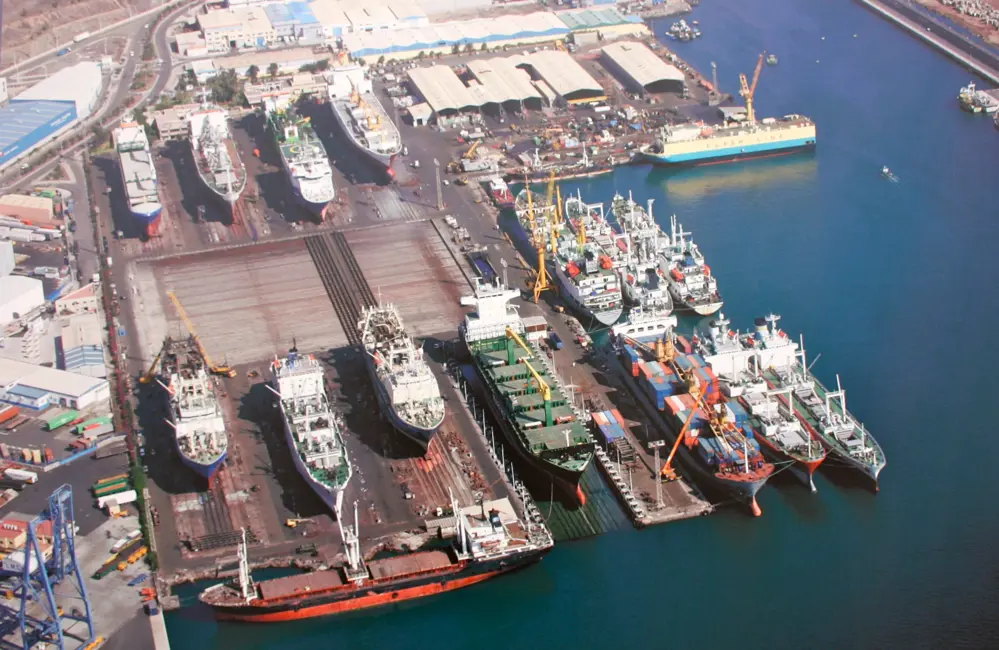
Syncrolift® has designed and delivered transfer systems worldwide for the last thirty years. We continuously apply this accumulated experience to improve our transfer systems.
55+ Transfer systems delivered
40 000 ton work load capacity
Fluid bed technology
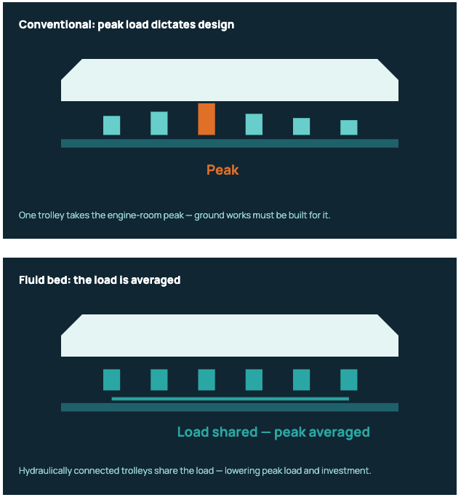
Most ships do not load evenly. Parts of the hull (typically around the engine room) carry far more weight than the rest. On a conventional transfer system, that peak load is transmitted straight into your ground works and shiplift, so both must be dimensioned for the heaviest point of the heaviest ship. The result is over-engineered civil works and a larger investment than the vessel's total weight would suggest.
Syncrolift's fluid bed technology solves this. Hydraulically connected trolleys share the load between them, averaging the peaks down — so your yard is engineered for the ship's real weight, not its heaviest metre. Lower peak load, lighter ground works, lower investment.
A shiplift can normally only serve one vessel at a time, but a yard with a transfer system can dry-dock as many ships as it has berths. Moving each vessel ashore frees the platform in minutes, so the lift is ready for the next docking.
Economy: Every hour a vessel occupies the shiplift platform is capacity you've paid for but can't sell.
Capacity = berths, not lifts/docks. Work on as many vessels as your yard has dry berths.
Speed of service: Undock in any order. No last-in-first-out = an urgent repair never waits behind a scheduled survey.
Scalability: Scale with land, not new docks. Adding berths costs a fraction of a second dock.
That is why shipyard operations research describes the ship transfer system as the critical bottleneck of shipyard throughput: the transfer layout, not the lift, sets the ceiling on how many vessels you can work on at once.
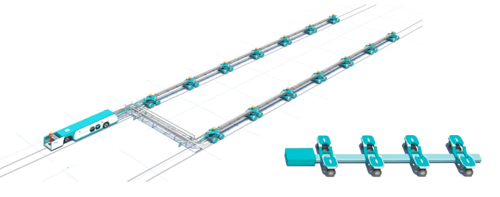
There are two main families of ship transfer systems: rail based or tyre based. The right choice depends on your ground conditions, yard geometry and target throughput. Syncrolift designs and delivers both, so our advice starts with your yard, not our catalogue.
Rail-based systems | Tyre-based systems | |
|---|---|---|
Ground conditions | Cost-efficient on soft soil (loads carried by rail foundations) | Need a firm, even surface; higher ground pressure |
Movement | Mainly x and y directions | Any direction, including rotation (past buildings and into halls) |
Lifting capacity | Highest. Up to 40,000 tonnes work load area | High. Suited to most vessels |
Yard utilisation | Fixed grid of berths | Park vessels anywhere on the transfer slab |
Systems | Fluid-bed · Rigid · DWB | FlexTrolley (SPMT) · Multi-wheeler · SPMT · PWT |


